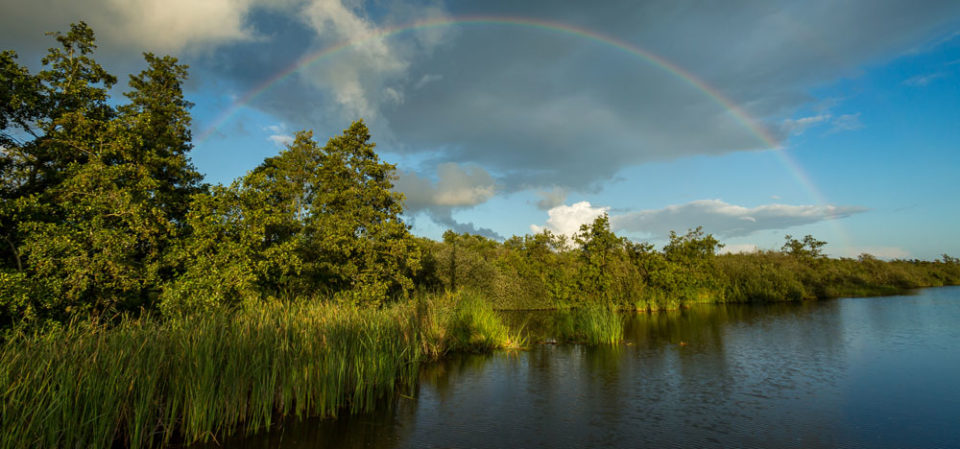
From the wide-open views across large stretches of water to the shelter of marsh forests — you will find it all in De Alde Feanen. The great diversity of landscapes creates a rich natural environment with many remarkable inhabitants. More than 450 plant species grow here and over one hundred bird species breed in the area.
Each part of the lowland peat marsh has its own inhabitants. The open water is home to many fish species, the extensive reed beds provide excellent shelter for a wide variety of marsh birds, and the flower-rich wet grasslands form ideal breeding grounds for meadow birds. It is no coincidence that experts regard De Alde Feanen as one of the most beautiful marshland areas in Northwestern Europe!
A large part of National Park De Alde Feanen has been designated as a Natura 2000 area. Read all about it here.
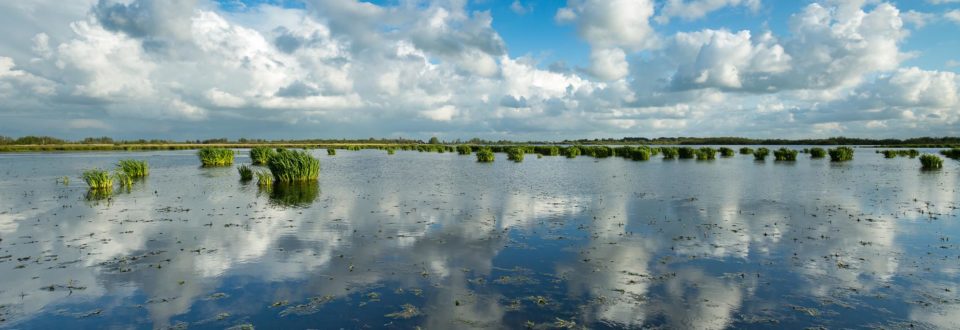
De Alde Feanen consists of approximately 425 hectares of open water — the equivalent of 425 ice-skating rinks combined! The water landscape includes canals, waterways, peat pools, ponds and lakes.
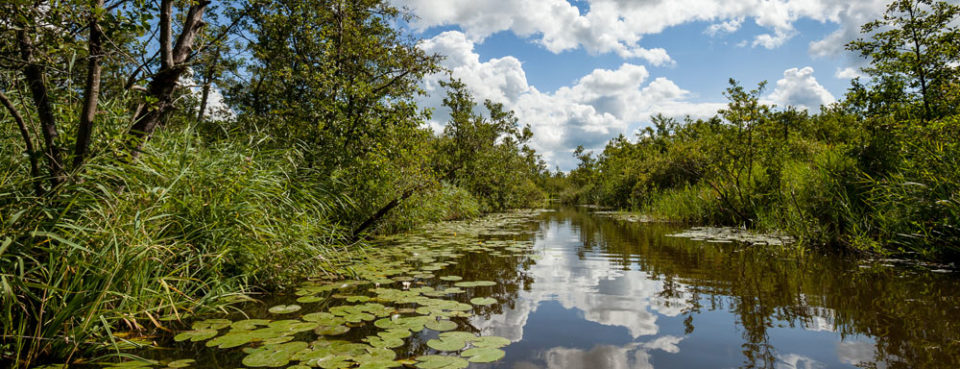
In the waters that are connected to the open waterways, few aquatic plants are found. In the more enclosed waters — such as the peat pools — the water quality is much better. Here you will find aquatic plants like the yellow water-lily and the white water-lily.
Besides plants, the waters of De Alde Feanen are home to around 20 species of fish. Here too there is a difference between the waters connected to the open waterways, where bream is commonly found, and the more enclosed waters, where species such as tench, perch, and pike live alongside bream.
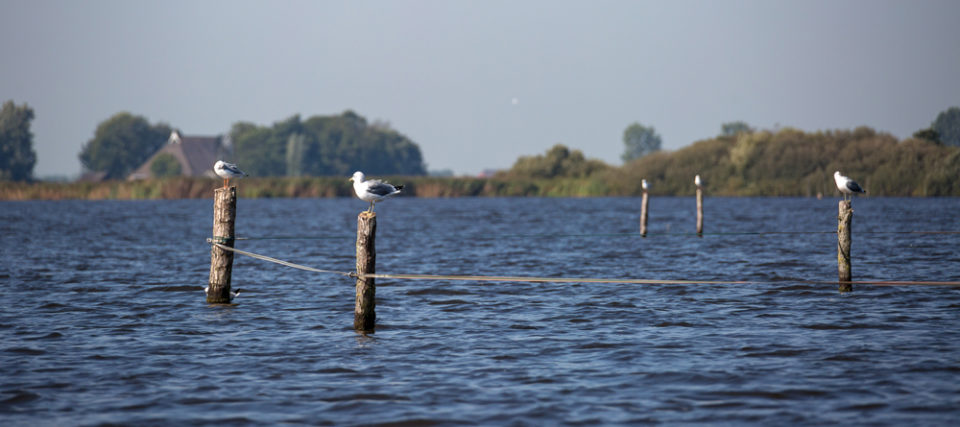
Where there are fish, there are birds. Here you may easily spot species such as the great crested grebe, cormorant, and grey heron flying overhead or hunting for food. You might even see a rare bird such as the purple heron or the Eurasian bittern.
The larger lakes also become important resting and stopover areas for waterbirds in autumn and winter, as long as the water does not freeze. During this time, thousands of ducks gather here, including Eurasian wigeon, mallard, gadwall, tufted duck, and common pochard.
The otter: with its whiskers, it senses vibrations in the water. This clever ability helps it detect fish, its favourite prey.
You may not spot an otter easily, but its traces can often be found — such as footprints or “spraints,” the distinctive name for otter droppings, which are one of the most recognizable signs of its presence.
In De Alde Feanen, three types of reed can be found. There is water reed, which grows in water up to one metre deep. There is transitional reed, which grows in shallow water. And there is land reed, which grows on solid ground along the banks.
Together, the reedbeds in De Alde Feanen make up a large part of the total area. Along the open waters of lakes and smaller waterways, extensive belts of reed can be found. Many fish use the reeds as spawning and shelter areas.
Reeds also provide marsh and water birds — such as the bearded reedling, sedge warbler, and reed bunting — with safe nesting and feeding places. In particular, older water reeds offer excellent nesting opportunities for several rare marsh birds, including the marsh harrier, Eurasian bittern, and various rail species.
The flower-rich reedlands are also very rich in insects.
Before peat extraction, a large part of the Frisian peat meadow landscape consisted of grassland. Today much less of it remains, but in De Alde Feanen you can still find large areas of grassland.
Only a few hectares of the special blue grassland remain.
The name likely comes from the blue sedge. Together with several other species, this plant gives the fields a blue-grey colour during the summer. Besides blue sedge, characteristic species include Spanish catchfly, flea sedge, blonde sedge, and purple moor grass. Various species of orchids also thrive in this rare type of grassland.
Where to find it? At De Rûne Sâne and De Twa Sân Mêden.
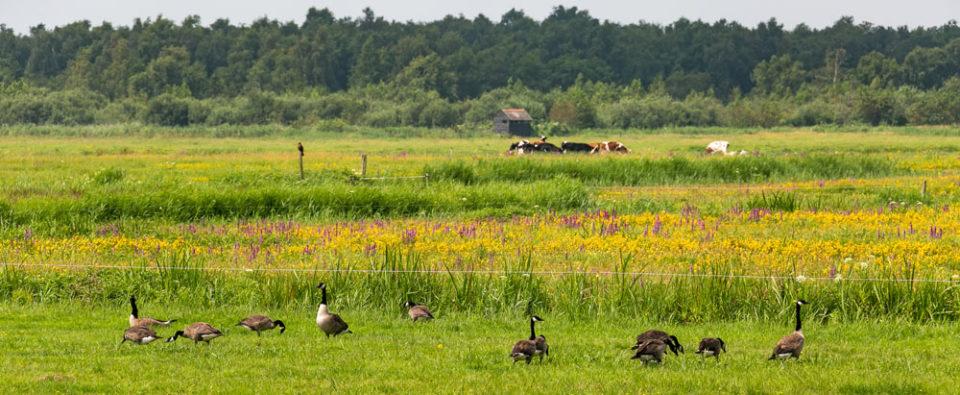
This type of grassland is named after the marsh marigold. Here you will find species such as marsh marigold, ragged robin, and marsh ragwort. Other commonly occurring plants include marsh thistle, yellow rattle, yellow loosestrife, and marsh bird’s-foot trefoil.
Many breeding birds can be found here, including demanding meadow bird species such as the ruff, corncrake, common snipe, black-tailed godwit, northern shoveler, and garganey.
In winter, the flooded grasslands become highly attractive roosting areas for thousands of ducks and geese. During autumn and early spring, thousands of waders — including black-tailed godwit, ruff, European golden plover, and northern lapwing — use these grasslands as feeding and resting areas.
Where to find it? At De Wyldlannen, Laban, and De Lange Sâne.
Tip! Vanaf de boot heb je in het voorjaar een prachtig uitzicht op de door dotterbloemen fel geel gekleurde graslanden.
The blue grasslands and marsh marigold hay meadows are largely flooded during winter. In the low-lying polder De Bolderen, however, this is not the case. For this reason, it is also known as a winter polder.
The polder is an important meadow bird area and a feeding ground for geese and Eurasian wigeon. Special plants can also be found here, including ragged robin, marsh thistle, and the marsh orchid.
Compared to the thousands-of-years-old landscape, the marsh forests in De Alde Feanen are relatively young. During the Second World War, almost all forests in the area were cut down due to the demand for firewood. By leaving these areas undisturbed for decades, valuable alder carr forests have developed.
In addition to the black alder, the grey willow is a characteristic species of these forests.
Here you will also find large amounts of buckthorn and wild honeysuckle. Along the edges of the forests — especially in the eastern part — the pleasantly fragrant bog myrtle grows.
These forests are rich in (crust) mosses, mushrooms, insects, and woodland birds. Birds such as the common buzzard, northern goshawk, and great spotted woodpecker breed here. Smaller songbirds — including the bullfinch, spotted flycatcher, and nightingale — find an abundance of insects here.
Roe deer and even the rare pine marten also feel safe within the shelter of the forest.
In the marsh forest of De Alde Feanen, there is a large cormorant colony of around 350 breeding pairs. This colony is located in De Princenhof, on the northern side of De Grutte Krite, and can only be reached by boat.
Cormorants are excellent divers. They can dive to depths of up to 30 metres to catch fish. If you see a cormorant standing on the shore with its wings spread, it is likely drying its wings after such a dive. Only once its feathers are dry can it take flight again.
One of the most impressive inhabitants of De Alde Feanen is the white-tailed eagle.
This imposing bird of prey is now making its second breeding attempt here. Follow the livestream 24/7 via the It Fryske Gea webcam and don’t miss a moment.



